


If you are someone with Autism, or any other invisible disability, and communicate differently as compared to the average majority , you would understand what it feels like when you are on the receiving end of the ‘stare’- that quizzical look on the face of a random stranger in a public place, who is visibly utilising all their thinking capacity to figure out how can someone look so ‘typical’ and still be so ‘different’ ? The very same annoying stare that most of us have been inoculated for, yet the annoyance of being stared at does raise it’s head once in a while, making you wonder about ways in which you can reclaim the narrative.
One day, as I was reading a book written by my favourite author, P G Wodehouse , I chanced upon this paragraph where the gentleman’s personal gentleman was counselling the gentleman on strategies to remain confident in front of a formidable brain surgeon who viewed this gentleman as a prospective inmate of the padded bin, all thanks to an unfortunate misunderstanding about twenty one cats in the gentleman’s bedroom. The gentleman’s personal gentleman wisely counsels the gentleman to mentally list the follies of the brain doctor in question, while in his presence, and also throw in some colourful language; all in his head of course. He then goes on to explain how listing another’s follies mentally would make them seem less formidable and threatening, thereby building on the gentleman’s confidence to speak his mind! This gave me a brilliant idea and all that I needed was an opportunity to try; and as for the opportunity, I actually did get it a couple of days ago.
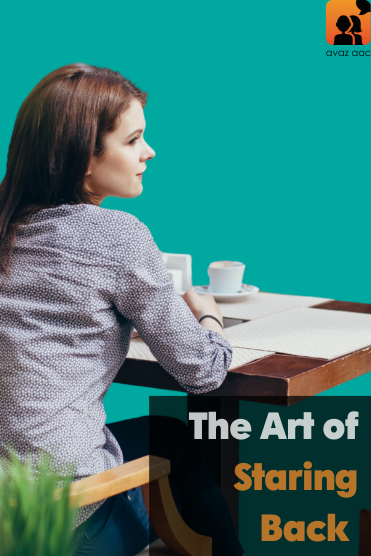
Readers who are familiar with the happenings in my life know that I begin my day with the customary morning walk. I walk in the walking path in my apartment, which at that time of the day, is inhabited by residents of all shapes and sizes. As I walked, I observed a toad jumping away right in front of me and I did not want to accidentally step on it. So I stopped walking and decided to let the toad leap out of my way. My mother, who was walking with me and had not seen the toad, asked me why I stopped. I began to type about the toad on Avaz when a middle aged woman who was walking in the opposite direction stopped to stare. Here was the perfect opportunity to try my strategy staring at me in face. I began to mentally remind myself that I had not seen this woman in these parts before. She was probably a visitor or a guest, and the way she was dressed for a morning walk, she came across as someone from a small town who was desperately trying to fit in, but doing a bad job of it! And lo and behold, I stared back into her eye- the most intensive stare that my big eyes could muster, and in a few seconds she went huffing away, only not to stare at me again!
Elated with the grand success of my strategy, I promptly finished my walk and headed back home , and forgot all about the incident, as I got busy with the day’s work . Sure enough, I was back for a walk next morning, and I chanced upon the same woman out on her walk; and when she saw me, she put her head down and went her way, even as I mentally congratulated myself on having given her a taste of her own medicine. I also thought about the conversations that I have had with my therapist about the ‘Spotlight Effect’- the feeling that maybe I am being watched by people around me, the feeling that possibly contributes to the existence of social anxiety. The more I thought about it the more I realised that the feeling of ‘being in the spotlight’ arises from the experience of having ‘been in the spotlight’ and the inoculation is not fully effective unless a conscious effort is made to reclaim the narrative. We humans are diverse in our very existence. Some of us are outliers in the way we experience the world and communicate, yet others are outliers because they don’t want to belong to where they come from. What is common, though, is that we each have a right to take space and be the way we wish to be, and this is a thought that I want to leave the ‘starers’ with.
Avaz Megaphone is a platform for neurodivergent individuals to express themselves through the written word. We accept opinion pieces, short stories and poetry. Authors of accepted works will receive an honorarium. To make a submission please email us on: collaborate@avazapp.com
WRITTEN BY
Aditi Sowmyanarayan
Student & Writer
Aditi Sowmyanarayan is a nineteen year old who uses Avaz, a text to speech app, to communicate. She goes to Ishanya India Foundation, a special school in Bengaluru. Aditi is an avid blogger and an aspiring writer. She blogs on www.smallstepbigthought.blogspot.com
She can be reached on Instagram at writeaditi and on her Facebook page : small step big thought