


Expression is everything that is ever needed to reach out and relate to another person, to understand the other’s thoughts, feelings and perspective, to forge a friendship, and to build a bond. Marriage, many believe, is the most complex bond of them all. Fair enough, I guess- for choosing to build a life with another adult has a sense of permanence attached to it. While that is a scary thought, it also entails thoughts about the level of communication that is needed to be so much in sync with another adult, so as to be able to commit to a lifetime of togetherness. But does this communication have to be verbal for the relationship to work?

I meet an interesting couple ,who are probably in their late thirties, and parents to two primary school going boys, when I go for my morning walk. They promptly drop their sons at the apartment gate, from where the school bus picks up the boys, and set out on their morning walk. They walk for over forty minutes, all the while, deeply and fully in conversation with each other using sign language. They are adults who are deaf and both of them have cochlear implant in one ear. While the wife does speak verbally a little bit, the husband speaks only in sign language. But speak, they do ! They are so present in the conversation, taking in everything that the moment has to offer, and truly listen to what the other has to say! A textbook example of what conversations between two people who share a life and two children should look like- yet, how many neurotypical couples with young children, whose lives are marked by routine and predictability, remain entirely in the conversation, keenly focused and genuinely engaged, without getting distracted by their phones or a million other things, when they go for a routine walk on mundane mornings?
The couple in question have been living in my apartment complex for a few years now, and turns out they are aware about my body of work, all thanks to their neighbour who happens to be my parents’ friend. They had also watched a couple of shows on Netflix featuring autistic protagonists, and this had piqued their curiosity enough to want to talk to me. Sure enough, they waved a hesitant ‘Hi’when I went past them during my morning walk. I stopped and typed a ‘Hi’ on Avaz on my iPad and showed it to them. They quickly pulled out the notes app on their phones and typed, ‘Hi’, and thus began our conversation. When I think back about the day I first spoke to them, what stands out for me is the sense of ease that I felt while having the conversation. For someone with clinical level social anxiety it sure is a big deal ! Maybe it’s the comfort associated with talking to people who ‘talk differently’, whatever be the reason. It also reminded me of this retail assistant in my favourite store who is deaf and communicates with gestures. She unerringly gets the size and shade of the garment I ask for after reading what I type . She is the shop assistant I look for every time I go to the store.
Communication is vital for human existence, but there are so many ways for us to ‘talk’. The unwillingness to accept this truth is, by far, the biggest disability of them all!
Avaz Megaphone is a platform for neurodivergent individuals to express themselves through the written word. We accept opinion pieces, short stories and poetry. Authors of accepted works will receive an honorarium. To make a submission please email us on: collaborate@avazapp.com
WRITTEN BY
Aditi Sowmyanarayan
Student & Writer
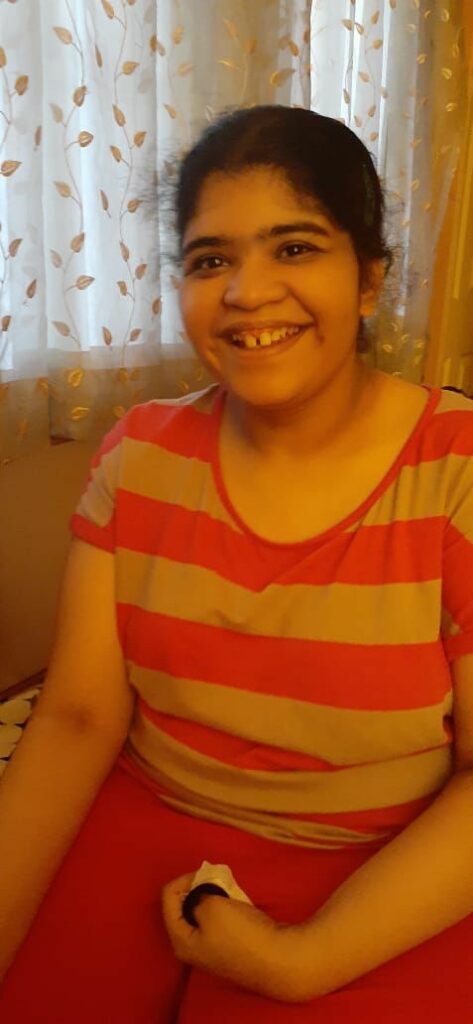
Aditi Sowmyanarayan is a nineteen year old who uses Avaz, a text to speech app, to communicate. She goes to Ishanya India Foundation, a special school in Bengaluru. Aditi is an avid blogger and an aspiring writer. She blogs on www.smallstepbigthought.blogspot.com
She can be reached on Instagram at writeaditi and on her Facebook page : small step big thought