


It doesn’t start with words. It starts with connection.
A child reaches for a toy, looks at you, and hums a familiar tune. Is that communication?
In the SCERTS framework, the answer is yes. Because communication is not just about words. It is about connection, emotion, and shared understanding.
SCERTS helps us see communication differently. Not as something to “teach,” but something to build together.
What is SCERTS?
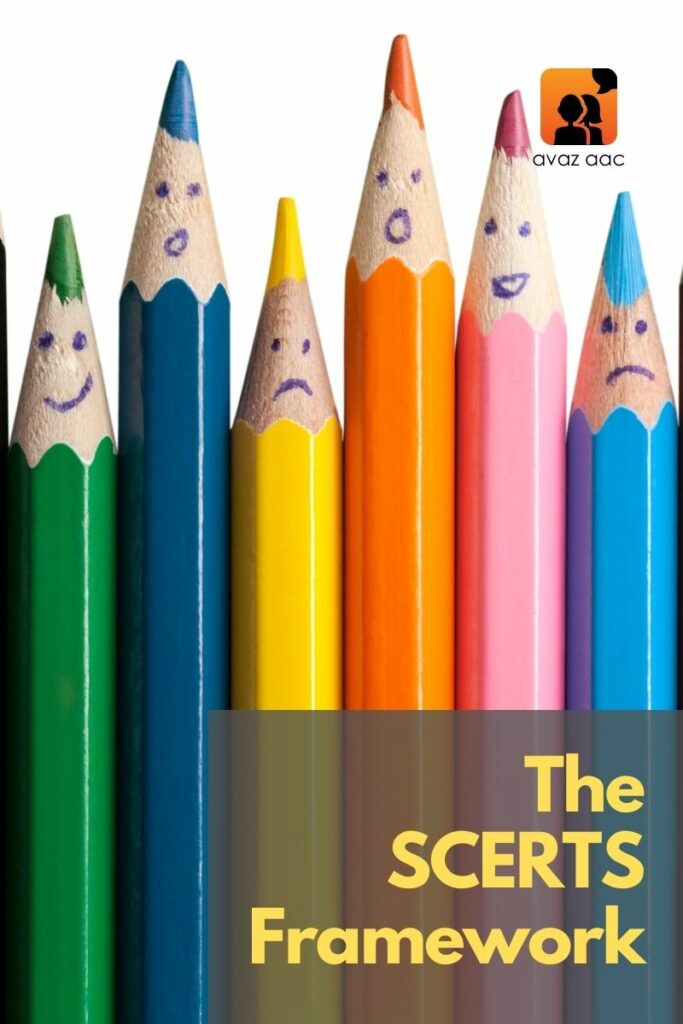
SCERTS is a research-based approach that focuses on helping individuals develop:
- Social Communication (SC)
- Emotional Regulation (ER)
- Transactional Support (TS)
It is especially useful for autistic and other neurodivergent individuals.
Instead of focusing only on language, SCERTS looks at the whole child. How they connect, how they regulate, and how we support them.
The 3 Core Areas of SCERTS
1. Social Communication: More than words
Social communication is the backbone of building secure relationships with others. This happens through emotional expressions as well as communication, both spontaneous and functional. It can be gestures, eye gaze, facial expressions, words or AAC taps.
The key idea is that communication is valid, even without speech.
Emotional Regulation
Before a child can communicate, they need to feel regulated.
Emotional regulation is about:
- Managing sensory input
- Coping with daily challenges
- Staying engaged in interactions
For some children, this might look like:
- Jumping or swinging to increase energy
- Holding a favorite object to calm down
The key idea here is that regulation comes before communication.
Transactional Support
This is where parents, therapists, and educators come in. SCERTS is a partnership based model. Transactional Supports are the plans that help the intervention team, including parents, to support the child.
Transactional supports include:
- Adjusting the environment
- Using AAC tools
- Modeling communication
- Responding to the child’s cues
Under SCERTS, Social Communication and Emotional Regulation are the skills that are targeted. Transactional Support is the means by which it is achieved.
Understanding Where the Child Is
SCERTS identifies three developmental stages:
- Social Partners
Pre-symbolic communicators with an intent of communication, use gestures and other modes of communication.
- Language Partners
Emerging/Early language developers who are symbolic communicators, single word communicators. Children with Echolalia are also categorized under this stage.
- Conversational Partners
Conversational partners are at a stage of combining multiple words in novel ways and sentences to communicate ideas.
Why this matters:
We don’t expect sentences from someone who is still learning to connect.
We meet them where they are.
Implementation of SCERTS
SCERTS model has a questionnaire that helps to determine the stage of development. Once this is done, we can identify appropriate goals and supports.
The strategies for Emotional Regulation may vary depending on the developmental stage of the individual. An individual in the social partner stage of development, doesn’t employ symbolic communication yet. Hence the only strategy available for emotional regulation may be of sensory/motor kind. Some sensory/motor strategies include physical activities like running, jumping, swinging to increase energy. Chewing gum or holding a favorite object to decrease arousal are also helpful.
What about an individual who is in the language partners stage, you may ask? For them, language based strategies that help them use words, symbols, or phrases to convey their emotional state are suggested.
For conversational partners, reflective and forward thinking strategies that help them self-regulate and seek mutual regulation are suggested.
What Does This Look Like in Real Life?
Let’s take emotional regulation as an example.
- A Social Partner might need sensory support like movement.
- A Language Partner might use words or AAC to say “help” or “break.”
- A Conversational Partner might reflect: “I feel overwhelmed.”
Same goal. Different path.
Communication independence is an important milestone as it guides in choosing the appropriate goals and strategies for the individual.
Supports Emotional Regulation
SCERTS model derives its foundation in embracing, understanding, and supporting various learning styles. It is one of the few interventions that acknowledges Echolalia in its developmental stage.
SCERTS model looks at Echolalia not only as a means of communication but also as a means of emotional regulation. Echolalia is repetitive and consistent. For some children, this can be a good self regulation mechanism during stress. Echolalic phrases can be used as a safe place to go, that is comfortable, familiar and predictable.
Echolalia also serves the function of informing us about the feelings of the individual. For instance, a repetition of dialogue from their favorite TV show may be an expression of boredom. It is just like how adults sometimes replay scenes from an interesting event in their heads when they are bored. Children with Echolalia might be replaying the scene along with the dialogues.
For instance one of the goals of SCERTS is to:
“Facilitate segmentation of echolalic forms with rule induction allowing for greater creativity in language production, and movement to more conventional forms.”
SCERTS is built from the perspective of embracing and honoring the learning style that accompanies Echolalia. It aims to work with it, rather than against it.
How AAC Fits into SCERTS
AAC plays a powerful role in all three areas:
- Supports social communication through accessible language
- Helps with emotional regulation by giving words to feelings
- Enables transactional support through modeling and consistency
When used well, AAC becomes more than a tool. It becomes a bridge.
3 Practical Takeaways You Can Try Today
1. Follow the child’s lead
Start with what they are already doing. Build from there.
2. Support regulation first
If a child is overwhelmed, communication can wait.
3. Model, don’t demand
Use AAC yourself. Show how communication works.
The Most Important Principle: Choice
SCERTS and other frameworks may help in setting goals and building competence in social communication and emotional regulation skills. Alongside this, it is important to know that the choice of using that skill still lies with the individual. Forcing a child or an individual to use the skill can result in masking. The intent is to build competence and not force them to mask the difference.
Just because someone can communicate a certain way, does not mean they must.
- A child may prefer AAC over speech
- Text over face-to-face interaction
- Silence over responding
Respecting these choices is acceptance.